
Top Steel Stair Manufacturers & Fabricators in the Ohio Valley » Steel Stair Safety & Compliance Standards » OSHA Standards: How to Choose Between Stairs and Ladders
OSHA Standards: How to Choose Between Stairs and Ladders
Index
When planning access equipment for factories and warehouses, it is necessary to choose the appropriate equipment, such as stairs or fixed ladders, depending on the intended use and installation conditions. An incorrect selection may not only compromise worker safety but also fail to meet OSHA standards, potentially requiring corrective action.
OSHA stipulates different requirements depending on the type of access equipment and the installation angle. To help you decide whether to choose stairs or fixed ladders, this article explains the differences in the applicable standards and the safety measures required for each.
OSHA Classification Standards by Angle
| Type | Installation Angle/Slope (from the horizontal) |
|---|---|
| Standard Stairs | 30° to 50° |
| Ship Stairs | 50° to 70° |
| Fixed Ladders | 60° to 90° |
OSHA specifies a range of 30 to 50 degrees from the horizontal for standard stairs and 50 to 70 degrees for ship stairs. For ladders, OSHA's guidance indicates a range of 60 to 90 degrees from the horizontal. When installing stairs or fixed ladders, please check the OSHA requirements applicable to each type of access equipment.
Reference: Official OSHA (1910.25 Stairways)
https://www.osha.gov/laws-regs/regulations/standardnumber/1910/1910.25
Reference: Official OSHA (1910.23 Ladders)
https://www.osha.gov/laws-regs/regulations/standardnumber/1910/1910.23
When to Consider Installing Stairs
Stairs are suitable for routes that workers frequently travel or places where workers are expected to climb while carrying tools or materials. In areas that serve as routes for multiple people or also function as emergency evacuation routes, it is important to plan the access equipment after verifying the applicable safety requirements.
When to Consider Installing Fixed Ladders
In environments where stairs cannot be installed due to limited installation space, a fixed ladder may be appropriate. Fixed ladders are commonly used to provide access to rooftop equipment, tanks, and other elevated areas.
However, fall protection requirements may apply depending on the height of the ladder above a lower level and the date of installation. In particular, fixed ladders that extend more than 24 feet (approximately 7.3 m) above a lower level are subject to specific fall protection requirements. For new fixed ladders installed on or after November 19, 2018, a personal fall arrest system or ladder safety system is generally required. For detailed requirements, see OSHA 1910.28(b)(9).
Reference: Official OSHA (1910.28(b)(9) Fixed Ladders)
https://www.osha.gov/laws-regs/regulations/standardnumber/1910/1910.28
Different Safety Measures for Stairs and Ladders
| Item | Stairs | Fixed Ladders |
|---|---|---|
| Handrails and Safety Equipment | Handrails, stair rail systems, and guardrail systems must be provided as required by OSHA regulations | Must meet the safety requirements applicable to fixed ladders |
| Fall Protection Measures | Requirements for handrails, stair rail systems, and guardrails must be checked based on the applicable conditions | Fall protection may be required depending on the height above a lower level and the date of installation |
| Method of Movement | Workers ascend and descend by walking | Workers ascend and descend using the ladder's rungs or steps |
| Installation Space | Requires space based on the installation angle and stair dimensions | Can generally be installed in less space than stairs |
How to Choose the Right Access Equipment for Your Facility
Choosing between stairs and ladders requires a comprehensive assessment of multiple factors, including the installation angle, frequency of use, whether workers need to carry tools or materials, available installation space, and whether the access route also serves as an emergency evacuation route. It is essential to thoroughly evaluate the facility's intended use and installation conditions and select access equipment that meets the applicable OSHA requirements.
Reference: Official OSHA (1910.25 Stairways, 1910.23 Ladders)
https://www.osha.gov/laws-regs/regulations/standardnumber/1910/1910.25
https://www.osha.gov/laws-regs/regulations/standardnumber/1910/1910.23
If You Are Considering OSHA-Compliant Stairs or Fixed Ladders
When installing access equipment in factories or warehouses, you need to choose between stairs and fixed ladders while also ensuring that the applicable OSHA requirements are met based on the intended use and frequency of use.
If you are considering access equipment for your facility, such as standard industrial stairs, roof access stairs, or fixed ladders for maintenance, consider consulting experienced manufacturers or specialists from the initial design stage. By receiving support in evaluating project conditions and confirming applicable safety standards, you can help your project proceed smoothly.
[Advertisement]
Find the Right Manufacturer by Stair Type
Find the Right Manufacturer by Stair Type
Compare manufacturers for egress, decorative, and industrial stair applications in the Ohio Valley.
Advertiser Disclosure:
We receive compensation from some of the companies listed below.This compensation may affect which companies are included and the order in which they appear.
For
Emergency
Egress Stairs
Emergency
Egress Stairs
SY Stairs
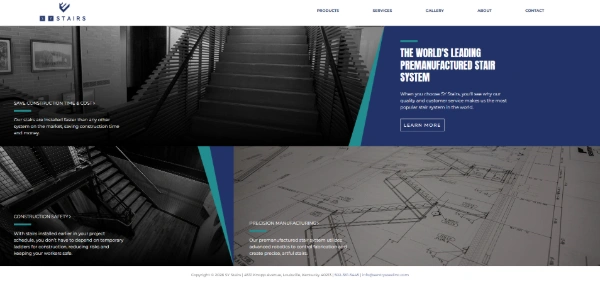
source : SY Stairs Official Website(https://systairs.com/)
- A fully modular design with integrated handrails eliminates the need for on-site welding or specialized labor. Compared to traditional field-assembled systems, installation is over 70%* faster, allowing follow-on trades to start work much sooner.
- Designed to meet building codes across the Ohio Valley, these stairs are ready for permanent use from day one. By eliminating the need for temporary ladders, they improve job site safety and accessibility.
| Key standards |
OSHA, AISC, AWS, etc. |
|---|---|
| Typical lead time |
6 to 8 weeks |
| CAD data | Available |
For
Decorative
Monumental Stairs
Decorative
Monumental Stairs
American Stair
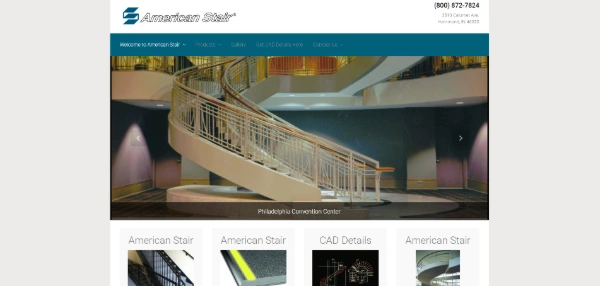
American Stair Official Website
(https://www.americanstair.com/)
- With proprietary custom design, the company delivers complex circular, spiral, and cantilevered stairs, creating iconic staircases that become a building’s architectural focal point.
- Advanced monumental stair solutions combine steel structures with materials such as glass, wood, and stone to deliver a refined, high-end finish with lasting strength.
| Key standards |
IBC, OSHA, etc. |
|---|---|
| Typical lead time |
8 to 12 weeks |
| CAD data | Available |
For
Industrial
Dock Stairs
Industrial
Dock Stairs
Upside Innovations
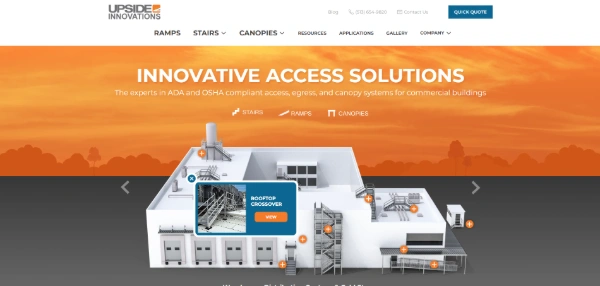
Upside Innovations Official
Website(https://upsideinnovations.com/)
- Crafted from industrial-grade aluminum, these stairs resist rust even in humid loading areas and outdoor installations. That helps maintain a clean appearance and dependable structural strength for long-lasting safety.
- Bolt-on assembly means your stair can be installed in just a few hours with a forklift and a small crew, keeping your jobsite moving with minimal disruption.
| Standards | OSHA,ADA, etc. |
|---|---|
| Lead time | Contact for details |
| CAD data | Contact for details |
*Based on SY Stairs' internal comparison between its modular pre-fabricated system and traditional field-assembled (stick-built) steel stair systems.
Results may vary depending on project scale, site conditions, and crew size.
Results may vary depending on project scale, site conditions, and crew size.
*Information as of February 2, 2026