
Top Steel Stair Manufacturers & Fabricators in the Ohio Valley » Steel Stair Safety & Compliance Standards » OSHA vs. IBC Stair Requirements: Which Code Applies to Your Project?
OSHA vs. IBC Stair Requirements: Which Code Applies to Your Project?
Index
When planning a steel stair project, one of the most common questions is whether the stairway should comply with OSHA standards or the International Building Code (IBC). Although both sets of regulations focus on safety, they were created for different environments and different users.
Selecting the wrong standard can lead to unnecessary costs, failed inspections, project delays, or safety concerns. Understanding the differences between OSHA and IBC stair requirements is essential for facility managers, architects, contractors, and building owners who want to ensure both compliance and cost-effective design.
The Fundamental Difference Between OSHA and IBC
The most important distinction between OSHA and IBC is the group of people each standard is designed to protect.
OSHA (Occupational Safety and Health Administration) regulations are intended primarily for industrial workplaces such as factories, warehouses, manufacturing facilities, processing plants, and maintenance areas. The goal is to protect trained employees who regularly use the facility as part of their work.
IBC (International Building Code) requirements are intended for commercial, public, and mixed-use buildings where people of all ages and physical abilities may use the stairs. This includes office buildings, schools, hospitals, shopping centers, hotels, and government facilities.
Because IBC stairs are designed for the general public—including children, elderly individuals, and occasional visitors—the requirements tend to be more restrictive. OSHA standards, meanwhile, recognize that industrial workers often operate in environments where space efficiency and operational access are important considerations.
Understanding this difference is critical because the applicable code is determined by the function of the stairway and who will use it, not simply by the building itself.
Key Dimensional Differences: Risers, Treads, and Slopes
One of the most noticeable differences between OSHA and IBC standards involves stair dimensions. OSHA allows steeper, more compact stairways, while IBC requires gentler stair geometry to improve comfort and accessibility for the public.
| Requirement | OSHA | IBC |
|---|---|---|
| Maximum Riser Height | 9.5 inches | 7 inches |
| Minimum Tread Depth | 9.5 inches | 11 inches |
| Typical Stair Slope | 30°–50° | Generally much shallower |
| Primary Users | Workers and maintenance personnel | General public |
These differences significantly affect the overall footprint of a stair system, which can impact both project costs and available floor space.
Riser Height and Tread Depth Compared
OSHA permits a maximum riser height of 9.5 inches and requires a minimum tread depth of 9.5 inches. This configuration allows stairways to occupy less horizontal space while still providing safe access for trained workers.
IBC requirements are considerably stricter. The code generally limits risers to a maximum of 7 inches while requiring treads to be at least 11 inches deep.
This means that IBC stairways feature lower step heights and wider walking surfaces, making them easier and more comfortable for the general public to navigate.
The reasoning is straightforward: public stairways must safely accommodate children, elderly individuals, visitors carrying luggage, and people who may not regularly use stairs. As a result, IBC prioritizes comfort and accessibility, while OSHA focuses on practical industrial access and worker safety.
Staircase Slope and Angle Specifications
OSHA allows stairways to be installed at angles ranging from approximately 30 degrees to 50 degrees from horizontal. This flexibility enables engineers to design compact stair systems that fit within industrial facilities where floor space is limited.
IBC stairways generally require a much gentler slope due to the stricter riser and tread requirements. As a result, they often consume considerably more floor area.
For industrial facilities such as manufacturing plants, equipment platforms, and warehouses, the ability to use a steeper OSHA-compliant stair can provide valuable space savings without compromising worker safety.
Handrail and Baluster Spacing Regulations
Another major distinction between OSHA and IBC standards involves fall protection systems, particularly guardrails, handrails, and baluster spacing.
OSHA regulations focus primarily on preventing workers from falling from elevated surfaces. Guardrail systems must satisfy strength requirements and provide adequate protection for employees using industrial equipment and work platforms.
IBC requirements go further by addressing the safety of children and members of the public.
One of the most important IBC provisions is the so-called "4-inch sphere rule". Openings between balusters must be small enough that a 4-inch diameter sphere cannot pass through.
This requirement is intended to prevent children from slipping through guardrails or becoming trapped between vertical members.
By comparison, OSHA allows significantly larger openings in many industrial applications. In some situations, openings of up to 19 inches may be permitted depending on the type of railing system and location.
Because of these stricter spacing requirements, IBC-compliant stair systems typically require more balusters, additional fabrication, and higher material costs than comparable OSHA-compliant systems.
Space Utilization and Cost Implications
The dimensional differences between OSHA and IBC standards have a direct impact on project budgets and facility layouts.
IBC-compliant stairways generally require:
- Longer stair runs
- Larger floor openings
- Additional landing space
- More guardrail components
- Additional balusters
- Greater material quantities
As a result, IBC stair systems frequently occupy more square footage and cost more to manufacture and install.
OSHA-compliant stairs, on the other hand, are often more compact and efficient for industrial environments. They can provide safe access while minimizing disruption to production equipment, storage areas, and workflow.
Applying IBC requirements to an industrial stairway that only needs OSHA compliance can unnecessarily increase both construction costs and space requirements.
For this reason, determining the correct code at the beginning of a project is one of the most important decisions in the design process.
Which Building Code Applies to Your Steel Stair Project?
The appropriate code depends on the stairway's purpose, location, and intended users.
The following examples can help determine which standard may apply:
- Factory equipment access stair → Typically OSHA
- Warehouse mezzanine access stair → Typically OSHA
- Industrial maintenance platform stair → Typically OSHA
- Loading dock access stair → Typically OSHA
- Office building stairway → Typically IBC
- Hotel stairway → Typically IBC
- School stairway → Typically IBC
- Public emergency egress stair → Typically IBC
Some projects involve both standards. For example, a manufacturing facility may contain OSHA-compliant access stairs inside the production area while also requiring IBC-compliant stairs in office sections that are open to visitors.
Mixed-use projects can become especially complex because multiple codes may apply simultaneously.
When a stairway serves both employees and the general public, professional code analysis is often necessary to determine the appropriate design approach.
Need Expert Help? Consult with Our Steel Stair Fabricators
Determining whether your project requires OSHA compliance, IBC compliance, or a combination of both is not always straightforward. Every facility presents unique operational, spatial, and regulatory challenges that must be carefully evaluated during the design process.
Experienced steel stair fabricators can help assess your application, review applicable codes, provide engineering guidance, and develop a custom solution that satisfies both safety requirements and project goals.
Whether you need a compact industrial access stair, a code-compliant egress stair, or a fully customized steel staircase, consulting with professionals early in the project can help prevent costly redesigns and compliance issues later.
[Advertisement]
Find the Right Manufacturer by Stair Type
Find the Right Manufacturer by Stair Type
Compare manufacturers for egress, decorative, and industrial stair applications in the Ohio Valley.
Advertiser Disclosure:
We receive compensation from some of the companies listed below.This compensation may affect which companies are included and the order in which they appear.
For
Emergency
Egress Stairs
Emergency
Egress Stairs
SY Stairs
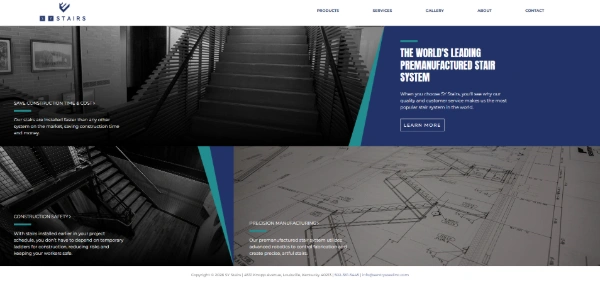
source : SY Stairs Official Website(https://systairs.com/)
- A fully modular design with integrated handrails eliminates the need for on-site welding or specialized labor. Compared to traditional field-assembled systems, installation is over 70%* faster, allowing follow-on trades to start work much sooner.
- Designed to meet building codes across the Ohio Valley, these stairs are ready for permanent use from day one. By eliminating the need for temporary ladders, they improve job site safety and accessibility.
| Key standards |
OSHA, AISC, AWS, etc. |
|---|---|
| Typical lead time |
6 to 8 weeks |
| CAD data | Available |
For
Decorative
Monumental Stairs
Decorative
Monumental Stairs
American Stair
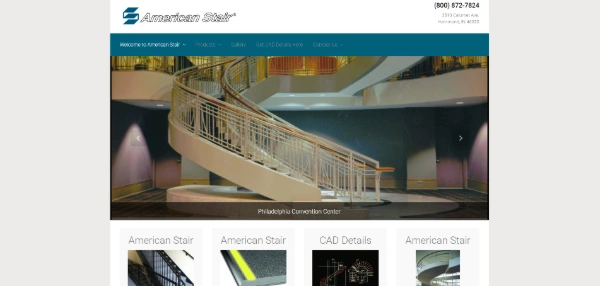
American Stair Official Website
(https://www.americanstair.com/)
- With proprietary custom design, the company delivers complex circular, spiral, and cantilevered stairs, creating iconic staircases that become a building’s architectural focal point.
- Advanced monumental stair solutions combine steel structures with materials such as glass, wood, and stone to deliver a refined, high-end finish with lasting strength.
| Key standards |
IBC, OSHA, etc. |
|---|---|
| Typical lead time |
8 to 12 weeks |
| CAD data | Available |
For
Industrial
Dock Stairs
Industrial
Dock Stairs
Upside Innovations
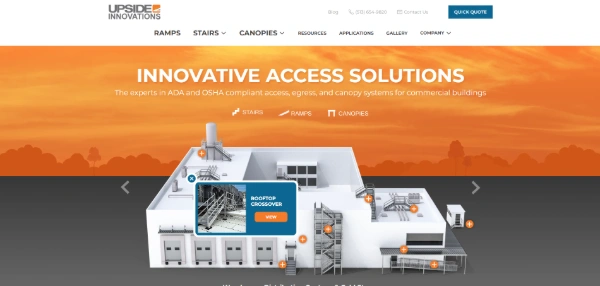
Upside Innovations Official
Website(https://upsideinnovations.com/)
- Crafted from industrial-grade aluminum, these stairs resist rust even in humid loading areas and outdoor installations. That helps maintain a clean appearance and dependable structural strength for long-lasting safety.
- Bolt-on assembly means your stair can be installed in just a few hours with a forklift and a small crew, keeping your jobsite moving with minimal disruption.
| Standards | OSHA,ADA, etc. |
|---|---|
| Lead time | Contact for details |
| CAD data | Contact for details |
*Based on SY Stairs' internal comparison between its modular pre-fabricated system and traditional field-assembled (stick-built) steel stair systems.
Results may vary depending on project scale, site conditions, and crew size.
Results may vary depending on project scale, site conditions, and crew size.
*Information as of February 2, 2026