
Top Steel Stair Manufacturers & Fabricators in the Ohio Valley » Steel Stair Safety & Compliance Standards » Prefabricated OSHA Steel Stairs: Fast, Compliant, and Cost-Effective
Prefabricated OSHA Steel Stairs: Fast, Compliant, and Cost-Effective
Index
Prefabricated OSHA stairs have become one of the most efficient solutions for industrial facilities that need safe, compliant access between different elevations. Instead of building stair systems piece by piece on the jobsite, prefabricated stair systems are engineered, manufactured, and quality-checked in a controlled factory environment before arriving ready for installation.
For facility managers, contractors, warehouse operators, and safety professionals, prefabricated OSHA-compliant stairs offer a faster, safer, and more predictable alternative to traditional field-built stair construction. This guide explains why pre-engineered stair systems are becoming the preferred choice across industrial environments.
Why Choose Prefabricated Stairs Over On-Site Fabrication?
For decades, many industrial stair systems were built through on-site fabrication. Steel components were cut, welded, and modified directly at the facility to fit the available space.
While this approach can work in certain situations, it often introduces significant challenges that increase project costs, schedule risks, and compliance concerns.
Common problems associated with on-site fabrication include:
- Unpredictable installation schedules
- Difficulty securing skilled welders
- Weather-related construction delays
- Inconsistent workmanship
- Potential dimensional inaccuracies
- Greater OSHA compliance risks
- Extended downtime around active operations
Even small dimensional errors can create problems when attempting to satisfy OSHA requirements for tread depth, riser height, handrail placement, and stair geometry.
Prefabricated OSHA stairs eliminate many of these challenges by shifting critical engineering and fabrication work from the jobsite to the factory.
Rather than relying on field adjustments, facility owners receive a professionally engineered stair system designed specifically for OSHA compliance and efficient installation.
Key Benefits of Pre-Engineered OSHA Metal Stairs
Pre-engineered OSHA metal stairs offer several advantages that make them attractive for warehouses, manufacturing facilities, distribution centers, processing plants, and industrial maintenance applications.
- ✔ OSHA-compliant design
- ✔ Faster project completion
- ✔ Reduced labor costs
- ✔ Improved dimensional accuracy
- ✔ Consistent manufacturing quality
- ✔ Simplified installation process
- ✔ Reduced facility downtime
- ✔ Lower long-term maintenance requirements
Because every stair system is manufactured using established engineering standards, facility owners gain confidence that the finished product will perform as intended.
100% Guaranteed OSHA Compliance
One of the biggest advantages of pre-engineered stair systems is the ability to achieve consistent OSHA compliance.
Factory manufacturing processes allow critical dimensions to be controlled with a level of precision that is often difficult to achieve through field fabrication.
Requirements such as:
- Tread depth
- Riser height
- Handrail height
- Guardrail placement
- Stair angle
- Structural load capacity
can all be incorporated directly into the design before production begins.
By using a stair system engineered around OSHA Standard 1910.25, facility owners can dramatically reduce the risk of inspection failures, costly modifications, and regulatory penalties.
Many manufacturers provide engineering documentation and drawings that further simplify compliance verification during project review.
Rapid Installation and Reduced Labor Costs
Unlike traditional field-built stair systems, prefabricated OSHA stairs typically arrive ready for assembly.
Many systems use a bolt-together assembly design, allowing installation crews to secure components using standard tools without extensive welding operations.
This approach offers several operational advantages:
- Minimal on-site fabrication
- Reduced dependence on certified welders
- Shorter installation schedules
- Lower labor expenses
- Reduced equipment requirements
- Less disruption to facility operations
For facilities operating around the clock, minimizing installation time can provide substantial savings by reducing downtime and avoiding disruptions to production activities.
Common Industrial Applications
Prefabricated OSHA stairs are used in a wide variety of industrial environments. Because they can be customized for different heights and configurations, they provide flexible solutions for many common workplace access challenges.
Mezzanines

Image source: Link Logistics (https://cms.linklogistics.com/wp-content/uploads/2026/02/Featured-Image-43.png)
Warehouse operators frequently install mezzanines to maximize vertical storage capacity without expanding the building footprint.
Prefabricated OSHA stairs provide safe access to these elevated storage areas while maintaining compliance with workplace safety requirements.
Because mezzanine projects often operate on tight schedules, bolt-together stair systems can significantly reduce installation time compared with field-built alternatives.
Loading Docks

Image source: Link Logistics Official Website (https://www.linklogistics.com/news/basics/what-is-a-loading-dock-a-guide-to-types-configurations-and-key-features/)
Loading docks are among the busiest areas of any warehouse or distribution center. Workers constantly move between truck yards, dock platforms, and building entrances.
Prefabricated OSHA dock stairs provide durable, safe access while helping reduce slip-and-fall risks in high-traffic environments.
Many facilities choose galvanized steel or aluminum stair systems for loading dock applications due to their durability and corrosion resistance.
Equipment Access

Image source: BilJax Official Website (https://biljax.com/industrial-maintenance-scaffolding-safe-access-for-complex-facilities)
Industrial equipment often requires routine inspection, servicing, and maintenance at elevated locations.
Prefabricated OSHA stairs are commonly used to provide permanent access to machinery, platforms, tanks, conveyors, processing systems, and rooftop equipment.
Compared with temporary ladders or makeshift access methods, engineered steel stair systems offer a significantly higher level of worker safety and operational efficiency.
How to Measure and Order Your Prefabricated Stairs
One of the biggest misconceptions about custom stair systems is that the ordering process is complicated.
In reality, most manufacturers require only a few key measurements to begin designing a compliant stair system.
The most important measurement is typically the floor-to-floor height, which represents the vertical distance between the lower and upper landing surfaces.
Once this measurement is provided, manufacturers can generally calculate:
- Required number of steps
- Tread depth configuration
- Riser heights
- Stair angle
- Landing requirements
- Handrail configuration
Additional information such as available floor space, environmental conditions, and desired materials may also be requested to ensure the final stair system meets project requirements.
Because the engineering work is completed before manufacturing begins, the ordering process is often much simpler than many facility owners expect.
Get a Fast Quote for Your Bolt-Together OSHA Stairs
If your facility needs a safe, durable, and OSHA-compliant stair solution, prefabricated bolt-together stair systems provide one of the fastest and most cost-effective options available.
Whether you are adding warehouse mezzanines, upgrading loading dock access, improving equipment maintenance routes, or replacing outdated stair systems, pre-engineered stairs can help reduce project timelines while maintaining full compliance.
By simply providing your floor-to-floor height and basic project information, experienced manufacturers can quickly recommend the appropriate configuration, calculate lead times, and prepare pricing.
For urgent projects, obtaining a fast quote can be the first step toward eliminating safety concerns and keeping your facility operating efficiently.
[Advertisement]
Find the Right Manufacturer by Stair Type
Find the Right Manufacturer by Stair Type
Compare manufacturers for egress, decorative, and industrial stair applications in the Ohio Valley.
Advertiser Disclosure:
We receive compensation from some of the companies listed below.This compensation may affect which companies are included and the order in which they appear.
For
Emergency
Egress Stairs
Emergency
Egress Stairs
SY Stairs
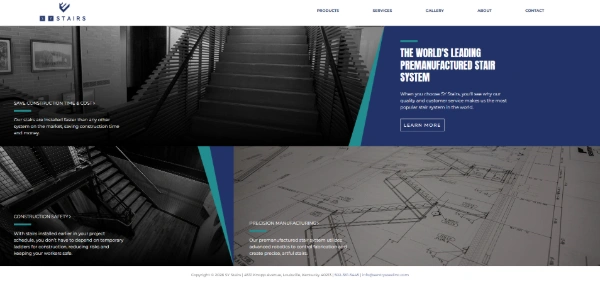
source : SY Stairs Official Website(https://systairs.com/)
- A fully modular design with integrated handrails eliminates the need for on-site welding or specialized labor. Compared to traditional field-assembled systems, installation is over 70%* faster, allowing follow-on trades to start work much sooner.
- Designed to meet building codes across the Ohio Valley, these stairs are ready for permanent use from day one. By eliminating the need for temporary ladders, they improve job site safety and accessibility.
| Key standards |
OSHA, AISC, AWS, etc. |
|---|---|
| Typical lead time |
6 to 8 weeks |
| CAD data | Available |
For
Decorative
Monumental Stairs
Decorative
Monumental Stairs
American Stair
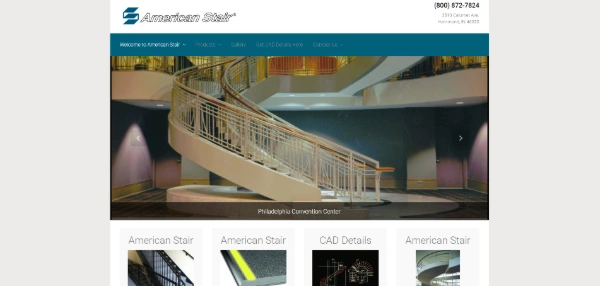
American Stair Official Website
(https://www.americanstair.com/)
- With proprietary custom design, the company delivers complex circular, spiral, and cantilevered stairs, creating iconic staircases that become a building’s architectural focal point.
- Advanced monumental stair solutions combine steel structures with materials such as glass, wood, and stone to deliver a refined, high-end finish with lasting strength.
| Key standards |
IBC, OSHA, etc. |
|---|---|
| Typical lead time |
8 to 12 weeks |
| CAD data | Available |
For
Industrial
Dock Stairs
Industrial
Dock Stairs
Upside Innovations
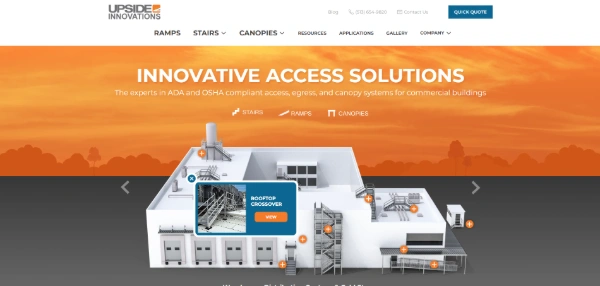
Upside Innovations Official
Website(https://upsideinnovations.com/)
- Crafted from industrial-grade aluminum, these stairs resist rust even in humid loading areas and outdoor installations. That helps maintain a clean appearance and dependable structural strength for long-lasting safety.
- Bolt-on assembly means your stair can be installed in just a few hours with a forklift and a small crew, keeping your jobsite moving with minimal disruption.
| Standards | OSHA,ADA, etc. |
|---|---|
| Lead time | Contact for details |
| CAD data | Contact for details |
*Based on SY Stairs' internal comparison between its modular pre-fabricated system and traditional field-assembled (stick-built) steel stair systems.
Results may vary depending on project scale, site conditions, and crew size.
Results may vary depending on project scale, site conditions, and crew size.
*Information as of February 2, 2026